Here are some of my favourite games / recommendations for specifically playing with 2 players. Most of them — if not all — will be small games because if I’m playing with someone, it’s happening somewhere outside home on a non-dedicated board game setting.
I’m excluding trading card games (and similar) such as Pokemon TCG and Magic the Gathering but those are the ones I most often do play.
Lost Cities
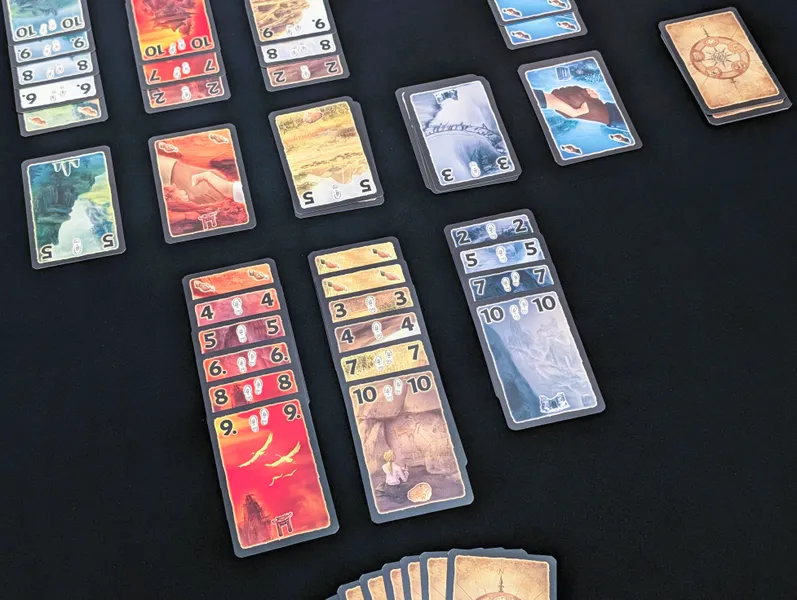
Lost Cities by Reiner Knizia is my all-time favourite 2 player game and I always keep cards for it with me when I leave home. Crucially, it’s designed for two players and only for two players which is often a good starting point.
Your goal is to gain as many points as possible by playing cards in five colors into your columns — or expeditions. Each color has cards in values from 2 to 10 (one of each) as well as 3 Investment cards. The twist is that once you play the first card in any expedition, it starts from -20 points. Investment cards add a multiplier to the final score for the column (1 of them makes it x2, 2 of them x3 and 3 of them x4) but beware, it also doubles the negative!
On your turn, you can do one of three things:
- Discard a card from your hand to the top of the shared discard pile for that color
- Pick a top most card from any discard pile
- Draw a card from top of the deck
The game ends immediately when the last card from draw deck is drawn. This means you can speed up the game by always drawing from the deck or stall by picking cards from discard.
During the game, you need to balance between advancing your expeditions, keeping valuable cards away from your opponent with hopes that they postpone starting their expeditions too late (or starting an expedition you hold most cards for) and pacing the gameplay to make sure you don’t run out of time to finish your expeditions.
It’s a super fun game. I really like the direct competition: every move you make has a potential ramifications to your opponent’s chances to score big.
It’s small and travel friendly: the deck is just 60 cards and it can be comfortably played on a train table or in a cafe as shown here when we played most of our train trip to PyCon Finland in 2025:
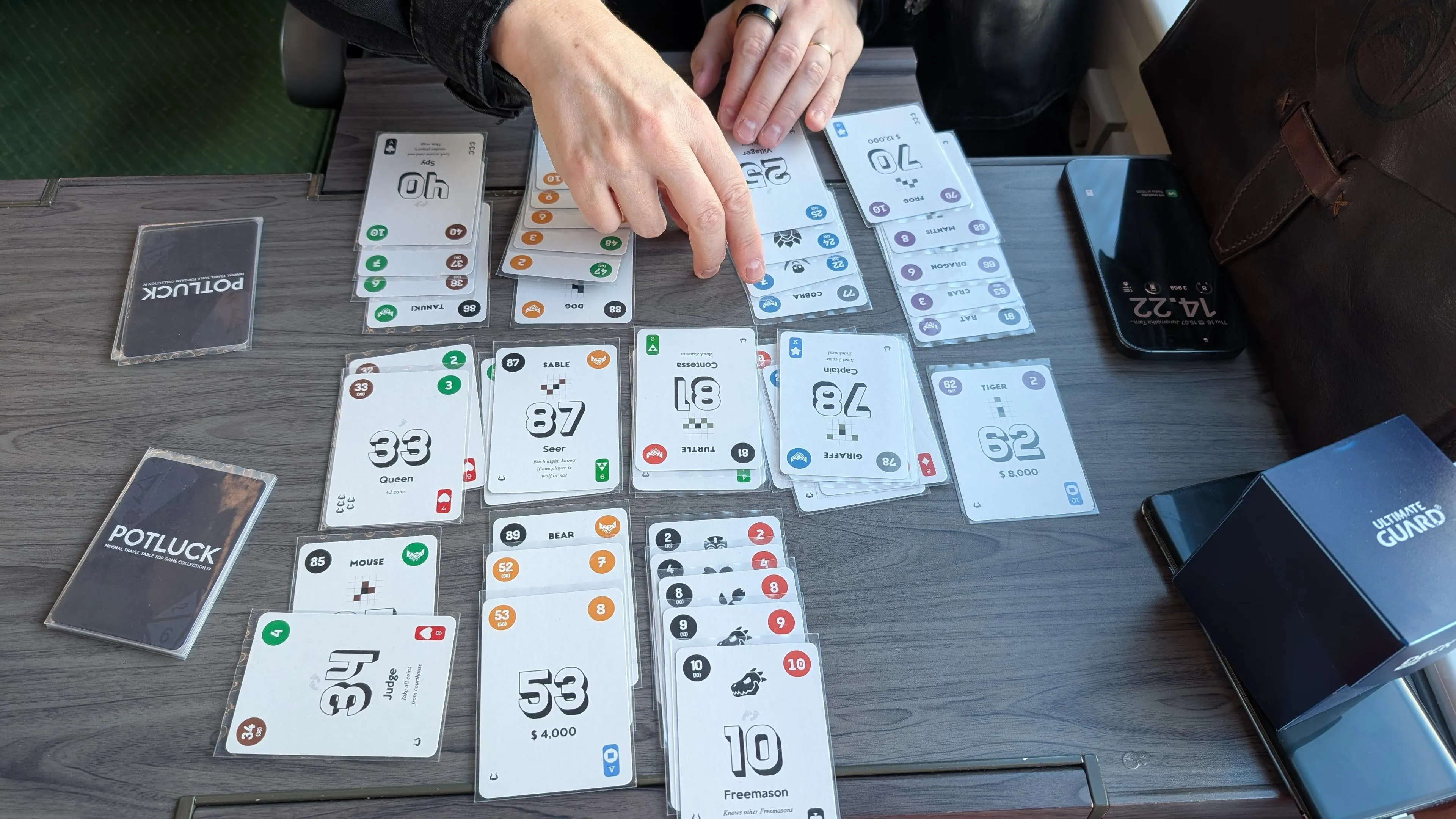 (It was played with Potluck cards instead of originals here)
Hive (Pocket)
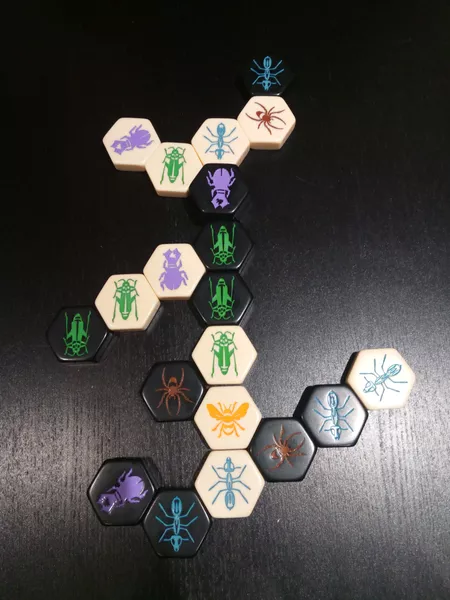
Hive by John Yianni and its smaller version Hive Pocket is a great tile-laying strategy game for two players.
In it, players place and move hexagonal tiles that have images of bugs on them. Each bug has unique movement and the yellow queen bee must be protected at all cost: the game ends when one of the queens is fully surrounded by tiles (either yours, your opponent’s or usually a combination of the two).
Shut Up & Sit Down has a great video about the game if you need convincing.
There’s no predetermined board or any extra tokens which is both a blessing and a curse as a travel game. Depending on how you place your bugs and how you move them around, you might need almost no space at all or a surprisingly long stretch of space. I wouldn’t try to play it in a train but on the other hand, it can be played on many outdoors environments where many other games do poorly. It is greatly enjoyable in pubs though!
Its Pocket variant is highly recommended over the regular one. Its tiles are still large enough to comfortably play but it fits into the backpack or sling way more comfortably, making it a no-brainer decision in my opinion.
The Fox in the Forest
The Fox in the Forest by Joshua Buergel is a good two-player trick taking game. The basic mechanic is the usual of the genre but each of the odd-numbered card has a special ability and winning the most tricks isn’t always the best strategy.
You get most points if you either win 0-3 or 7-9 tricks each round. More than 10 and you’re greedy and end up with 0 points. 4 to 6 and you gain little bit of points. I really like this type of scoring in trick-taking games that don’t purely favour those who get the most powerful cards to win the most (or least) amount of tricks.
All of my favourite trick-taking games land into that category in one form or another: in 7 Signum (or Sluff Off!), you need to make bets for how many you think you’ll win; Seven Prophecies makes you bet on each of the possible positions (from 1st to 4th) and in Texas Showdown / Seas of Strife you try avoid taking tricks but the winner is determined by the most played colour rather than the starting colour.
The Fox in the Forest is the only game at the moment on this list that I don’t own.
(A special shout out to Pico, another interesting two player trick-taking game. It just runs out of replayablity faster than this.)
Star Realms
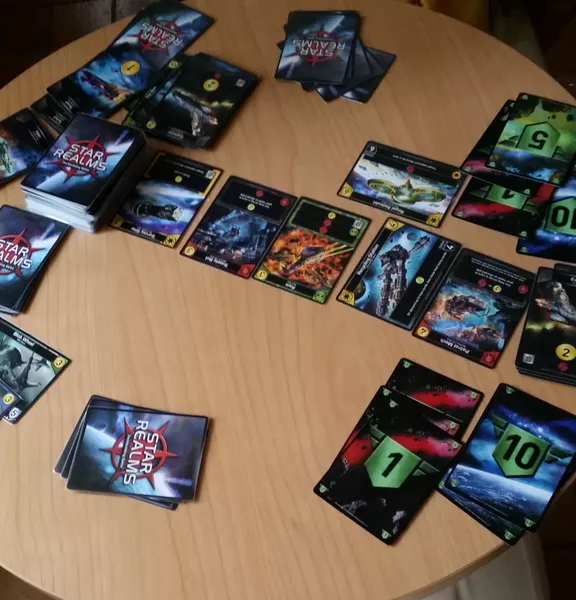 Photo by Andres Cervantes on BGG
Star Realms by Robert Dougherty and Darwin Kastle is a deck-building scifi space battle game in a pocket size. In it, two players start with a basic deck of simple attacks and money and use those to purchase cards from a shared market row to improve their deck and eventually deal enough damage to take out their opponent.
Every game is different (to some extent) based on what your opponent does and what the draw of the deck brings you. On each turn, you’re limited to buying whatever is available in a limited market so you can’t rely on the same strategy every game.
There are four different factions: blue Trade Federation, green Blob, yellow Star Empire and red Machine Cult. All of them have their own strengths and strategies and usually you end up combining two or three. The real power comes from friendship! A lot of the cards have ally powers that activate if you play another card from the same faction during your turn.
A lot of the deck building then boils down to building good combos and thinning out cards that don’t serve your strategy.
Travel friendly? You bet! All it takes is the cards and a small table to play at.
Tinderblox
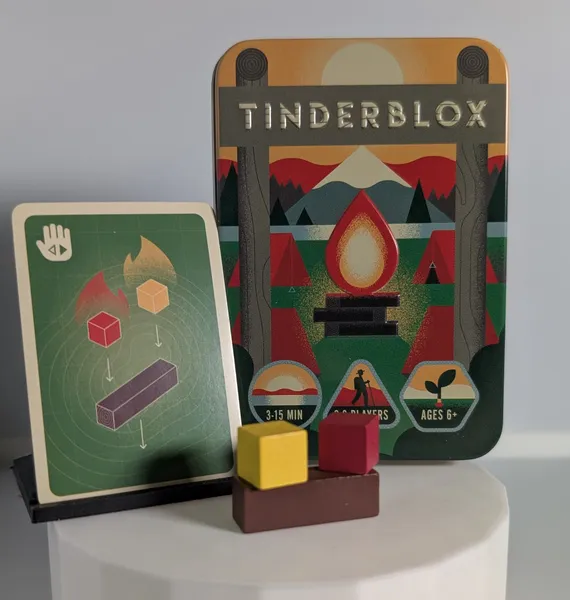
Tinderblox by Rob Sparks is a fun, tiny dexterity game. I always thought I didn’t like dexterity games until I bought this and brought it to an office game night. We all had so much fun with it. And it’s a game that works great for 2 players even if it’s not specifically designed for just 2.
In Tinderblox, you collectively build a camp fire by drawing cards that tell you which pieces you need to place. You use small tweezers to move pieces and they are small variations in piece sizes making them awkward to move in groups. If something falls, you’re out — and in two player game, lose the round and start another one.
It’s really travel friendly as it comes in a tiny tin and doesn’t take more than a playing card’s area (+ a bit extra to lay pieces down before lifting them). However, since it’s a dexterity game, you need a stable and flat playing area. You don’t want to give your opponent an opportunity to blame a shaking train for their loss, do you?
Tak
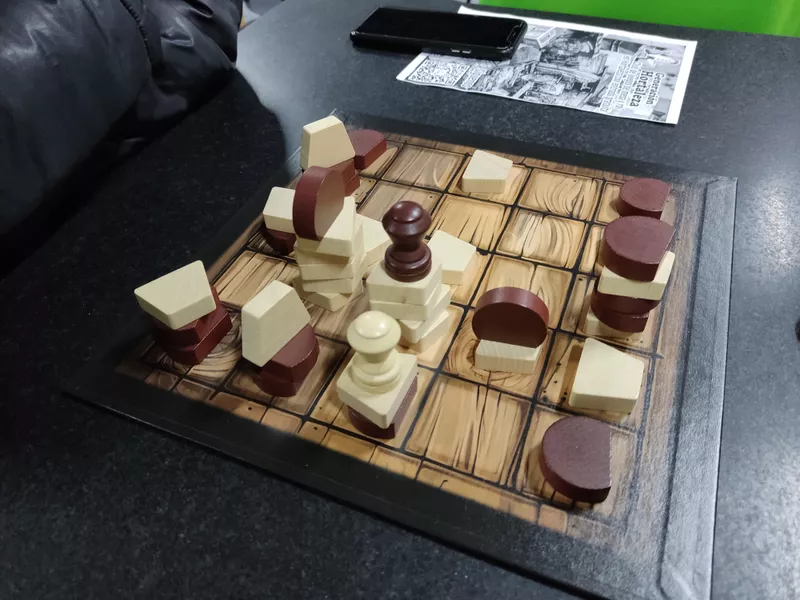 Photo by Generacion Hortaleza in BGG
Tak by James Earnest and Patrick Rothfuss is a 2-player abstract strategy game played in a grid similar to chess board but with pieces that are (almost all) the same.
I can’t do justice to this game with my words. Instead, I refer you to The Modern Rogue’s Youtube video Tak Is About to Be Your New Favorite Game
“The point,” Bredon said grandly, “is to play a beautiful game.” He lifted his hands and shrugged, his face breaking into a beatific smile. “Why would I want to win anything other than a beautiful game?”
It’s super travel friendly. You need a grid board but that can be anything really (I have one 5x5 grid printed on a mouse pad that I roll up and carry with me) and a small amount of tiles. In a pinch, you could take a piece of paper or cardboard wherever you end playing at and drawing the grid on it.
To win a game, you need to connect opposing sides with your tiles. Sounds simple? You forgot it’s not a solo game! There’s another player that has the same goal and thus, will block you from reaching yours.
I do kinda want to commission a really fancy (yet still travel sized) version with really nice and heavy tactile stones.
Onitama
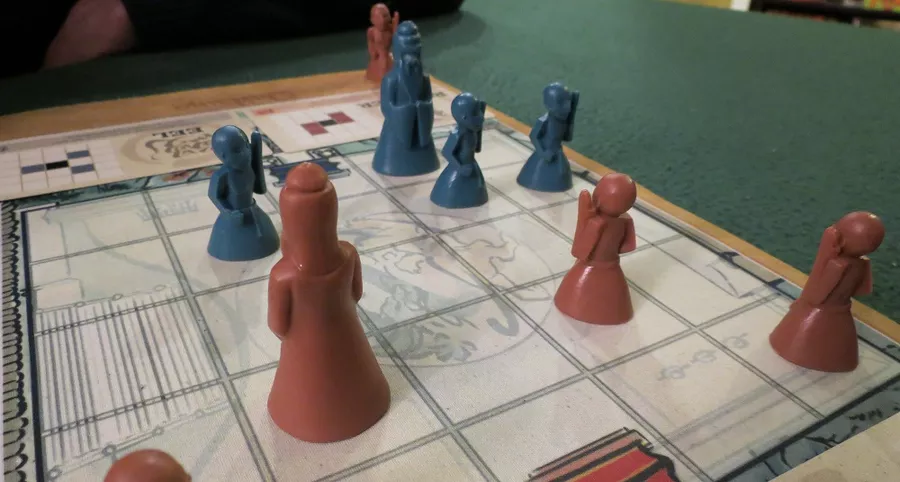
Onitama by Shimpei Sato is another chess-esque game. This time, instead of your moves being restricted by your pieces, they are restricted by 5 cards selected randomly from a deck of cards.
Players start with two cards each with the fifth card being available in the pool. They can choose to play a move from one of their cards and then they put that card into the pool and pick the extra card from there. You always know exactly what moves your opponent has access to in their next turn which makes this especially interesting.
Each player has four smaller pawns and one bigger pawn. You win the game by capturing your opponent’s main pawn or by placing their own main pawn to the opponent’s throne (center square in their starting row).
Great for travel! All you need is a stack of Onitama cards, a 5x5 grid (I use the same mousepad as I do for Tak above) and 10 pieces in two colors and two sizes per color. I use Carcassonne meeples in a ziploc bag.
Scuttle
Cuttle is a two-player battling game that can be played with a deck of regular playing cards (4 suits, 1-13 each). The cards can be either played for their numeric value (21 on your board to win) or used for their unique abilities.
Recommendations from others
When I shared this note originally in Mastodon, I got a plethora of recommendations. I have not yet played these myself but here they are as my list of games to try out.
- 60 Second City | Board Game | BoardGameGeek
- Beer & Bread | Board Game | BoardGameGeek
- Tides of Time | Board Game | BoardGameGeek
- Flatiron | Board Game | BoardGameGeek
- Compile | Board Game | BoardGameGeek
- Catan Card Game | Board Game | BoardGameGeek
- Netrunner | Board Game | BoardGameGeek / Android: Netrunner | Board Game | BoardGameGeek
- Targi | Board Game | BoardGameGeek
- Jaipur | Board Game | BoardGameGeek
- Agent Hunter | Board Game | BoardGameGeek
- Biblios | Board Game | BoardGameGeek
- Scrimish | Board Game | BoardGameGeek