The phrase “Reading the card explains the card” (apparently coined by the Professor at Tolarian Community College) has become a mainstay in the Magic the Gathering community.
In essence, it means that all of the relevant rules related to the card (ie. excluding general gameplay rules) are printed on the card so that you can pick up any card, read it and figure out what it does.
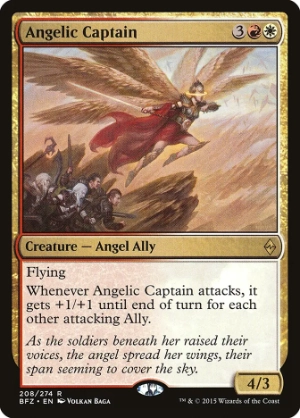
Some cards are indeed very well explained by reading the card. This Angelic Captain has Flying which is a keyword (Magic the Gathering has a ton of those, almost 200 at the time of writing). It has a very specific rule effect and is one of the basic keywords that are not usually written down on the card but rather expected that the players know how it works.
In Technical Writing In Tabletop Games, Sam Pearson discusses balancing between natural language and heavy jargon and keywords fall closer to the jargon edge: they are very terse (single word instead of a rule paragraph) but require players to know them to be effective.
I can read a Magic card and out of the about 200 keywords, I probably know 50 or so really well but I always keep MTG Wiki open on my phone when playing Commander with my friends because even the ones I kinda know, I often need to double check. Especially since there are so many that are very similar to each other but have some distinction.
One example of such a pair is Scry
*Scry 2. (Look at the top two cards of your library, then put any number of them on the bottom and the rest on top in any order.)
and Surveil
Surveil 2. (Look at the top two cards of your library, then put any number of them into your graveyard and the rest on the top of your library in any order.)).
In Scry, unwanted cards go to the bottom of the deck while in Surveil they go to the graveyard. Both are super common mechanics but I still don’t remember which is which.
Angelic Captain also has an activated ability that triggers when it attacks and is very self-explanatory and as such, a great example of the “Reading the card explains the card”.
Magic Kingdom’s article Does Reading the Card Actually Explain the Card? makes an excellent point from the perspective of standardising rules text:
One of the earliest and most important ways Magic evolved was by standardizing its rules text. If two cards produce the same kind of effect with their ability, it will be written the same way both times. Even if one card’s ability is activated and the other triggered, only part of the rules text will change, and it will change in a predictable way.
Making the language on cards so consistent means players can learn to read and “speak” that language, rather than just memorizing individual card effects. Once you become fluent in Magic-ese, the idea is that you should always be able to understand what the rules text describes even if you’ve never seen a particular card before.
Telling players “reading the card explains the card” is really a reminder of that principle: that learning how to read Magic rules is more important than learning and memorising every individual card.
It’s also a bit of jab at the fact that this is not exactly the case with all the cards. Rhystic Studies has a great article on Magic’s most ambiguous cards. The Command Zone has a 99 minute podcast episode about reading Magic cards. And there’s an official database Gatherer that has a ton of extra rulings for the more complex cards and how they interact with each other (see for example Cramped Bunker).
Another example (picked from Rhystic Studies’ article) is Balduvian Warlord that has seven extra rulings in its Scryfall page to help players understand the card.
Magic the Gathering is such an interesting game in that I have never read its rulebook. Someone once taught me the basics of how it operates and the rest is most often just reading the cards (and checking the wiki or Scryfall whenever I need to find out how a card interacts).
This is very different from board games for example where the main rulebook is much more prominent as the action doesn’t happen so dominantly via cards (or tokens, dice or other components) themselves but rather through general rules.