Trading card games (like Pokemon TCG and Magic the Gathering) are generally built around an idea that more cards are introduced over time — usually in “sets” with a chunk of new cards released at once — to keep the game going and to introduce new cards and mechanics.
To make the purchase of new cards more appealing to players, the companies designing these games often introduce power creep. It refers to the phenomenon that new cards are more powerful than the previous ones (more HP, more powerful effects, more powerful attacks and so on) so if you don’t want to lose to other players, you too need to put in the money to the table and keep up.
in Pokémon TCG
Mega Rayquaza and the power creep is a good example of this. In that note, I compare two Pokémon TCG cards: Rayquaza EX from 2012 and Mega Rayquaza ex from 2026.
Another reason power creep is introduced is more psychological one: players feel better about the new cards because they offer something better than the cards they already own. Even if we take out the fact that it increases your odds of winning against someone who doesn’t have it, playing better cards makes you feel more powerful.
JWittz has a good video on hit point power creep from 2019 and things have gotten even worse since then. The worst part to me is that it’s accelerating. When the game started in 1999, Chansey and Charizard both had 120 HP sharing the top of the list. It took 4 years to break that glass window by Wailord ex with 200 HP. But it took until 2011 for a Basic Pokémon to have more than 120 HP. 12 years.
In 2026, we have Mega Zygarde ex, a Basic Pokémon with 310 HP and Mega Venusaur ex as an evolution Pokémon with whopping 380 HP.
Here are the changes to the biggest HPs in Pokémon TCG:
| Year | Set | Biggest Basic | Biggest any stage |
|---|---|---|---|
| 1999 | Base Set | Chansey 120HP | Charizard 120HP |
| 2003 | EX Sandstorm | Chansey 120HP | Wailord ex 200HP |
| 2011 | Black & White | Zekrom / Reshiram 130HP | Wailord ex 200HP |
| 2012 | Next Destinies | Regigigas EX 180HP | Wailord ex 200HP |
| 2014 | XY | Regigigas EX 180HP | M Venusaur EX 230HP |
| 2015 | Primal Clash | Wailord EX 250HP | Wailord EX 250HP |
| 2019 | Team Up | Wailord & Magikarp EX 300HP | Wailord & Magikarp EX 300HP |
| 2020 | Sword & Shield | Wailord & Magikarp EX 300HP | Snorlax VMAX 340HP |
| 2025 | Mega Evolution | Wailord & Magikarp EX 300HP | Mega Venusaur ex 380HP |
| 2026 | Perfect Order | Mega Zygarde ex 310HP | Mega Venusaur ex 380HP |
in Magic the Gathering
Magic the Gathering podcast Distraction Makers has an episode on power creep in MTG. I haven’t played enough to have as good of a grasp of it than I have with Pokémon but Gavin explains the evolution of the game and its power creep in a nice way. He uses a metric that assigns point values to Creature cards based on their power, toughness and abilities to plot how they have gotten more powerful over time.
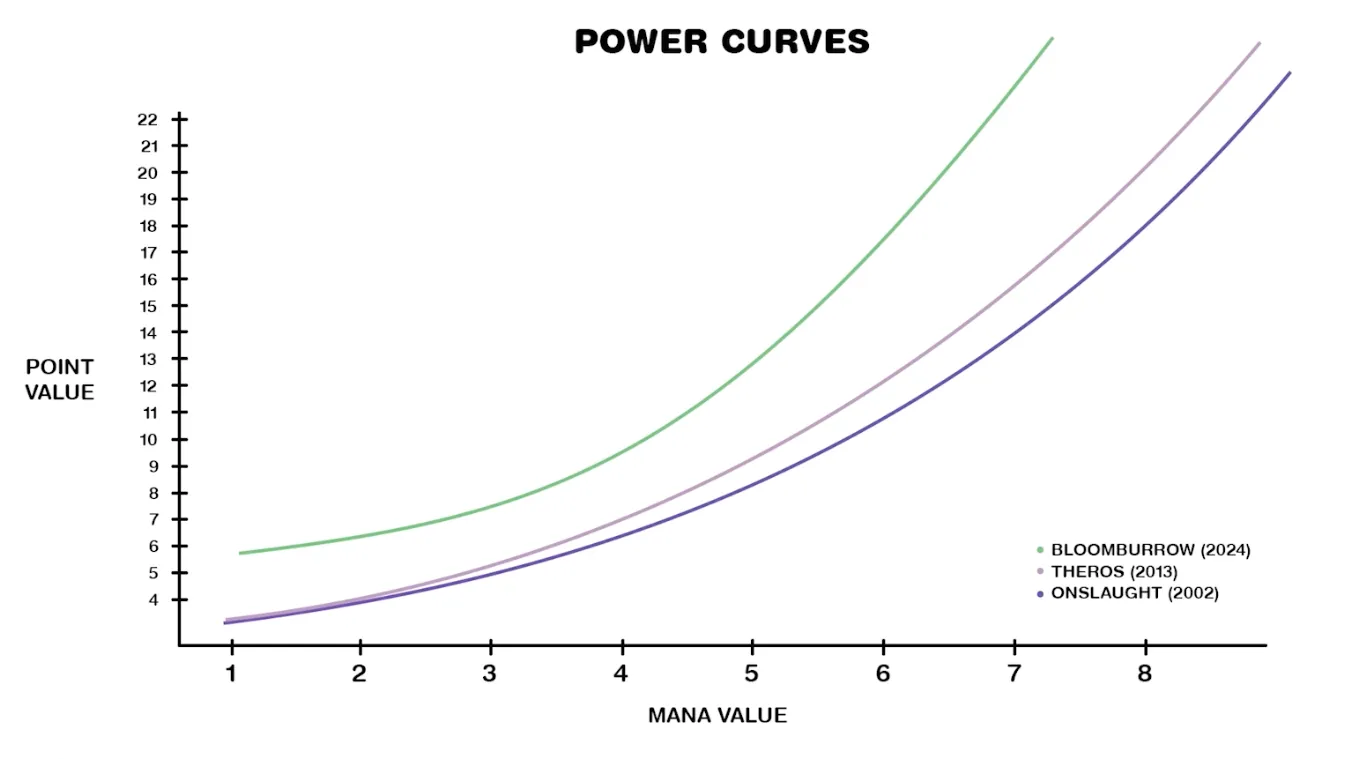
Graph by Gavin Valentine / Distraction Makers.
Another issue Magic the Gathering specifically has is the “superhero problem” in Magic the Gathering. In their Universes Beyond sets that bring in characters and worlds from non-Magic intellectual properties, they need to make the recognisable heroes and villains strong because players expect them to be strong.
The impact
I’m quoting Gavin:
And I think the consequence that we see for this is is the standard meta game in that it used to be somewhat of a slow format where there were a lot of sub games that could be played. Sub games meaning exchanges as you’re playing the game.
And if a card should present a problem, you and your opponent wrestle over that problem. If your opponent wins that one sub game, you don’t automatically lose the game. It’s just one of many sub games that you will play during the course of a game in order to determine who’s ultimately going to win that game.
But as power creep sets in, more threats become so powerful that each one of them must be answered or the game is over.
I feel this is very much the same as with Pokémon. The best eras of Pokémon have been when the game hasn’t been revolving around taking one-hit knockouts. Back and forth, strategic matches are way more interesting than “who can take 2 or 3 big KOs the fastest”.
Rotation helps in theory
Sometimes, the opposite is true. As Pokémon TCG has evolved, the design of the Trainer cards have mostly done a full 180 from the original designs. The original Trainer cards were incredibly powerful and would break any modern meta. So while Pokémon get bigger and badder, Trainers have been nerfed.
One way to combat all of this is through format rotation. In Pokémon, the Standard format that’s played in the competitive circuit, rotates out old cards once a year to give more room for new design decisions without having to worry about game breaking combos with decades worth of cards and of course to bring in more cash when old cards become useless (or find a new home with community formats like Gym Leader Challenge and Pokémon TCG PRC-GRI format).
I’m a strong believer in that a well-designed rotation system would make a TCG sustainable from functional perspective with zero or near-zero power creep. Competitive scene and new beautiful art for collectors could possibly still keep the financial part running.
The biggest reason people get new cards isn’t just because the older ones can’t compete with new ones. It’s that many events are organised with Standard format and you need the cards to even participate outside community events and kitchen table gaming.