Youtuber Perry Daniels published a series of videos describing his method for taking notes that help him be more creative. He calls this method the Grail Method.
- Creativity isn’t a gift, it’s a system, Perry Daniels
- Grail Method Q and A: Answering Your Biggest Questions, Perry Daniels
- Productivity stole your creativity. It’s time to take it back., Perry Daniels
He had some good points so I wanted to dissect the ideas here.
Interlude on hyperbole
I don’t want to bash his videos but the first minute of his first video is such bonkers Youtube content stuff that I couldn’t not mention it.
To kick this off, he claims — in a typical Youtube influencer ethos — that his method is “the method for more creativity, deeper learning and meaningful productivity”. First important thing is whenever someone claims their system to be such is to discard that message as hyperbole.
It might be the best system for him. I’m a strong believer in everyone discovering and building their own system because we are all different and adopting someone else’s system will lead to a ton of undesirable friction.
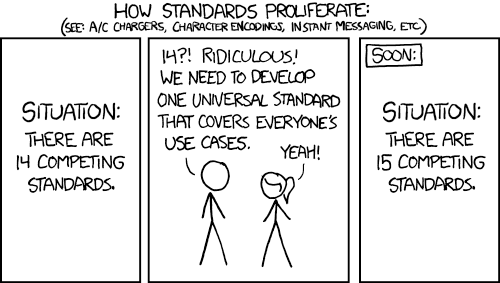
He talks about all the other popular methods that are all flawed but claims that his is the golden goose. That reminded me of the xkcd comic on standards above.
I am sharing my notes on it because taking inspiration from other’s systems is always a good idea even when directly copying or adopting someone’s system is not.
He has named it the Grail Method based on Henry Jones’s notebook in Indiana Jones movies.
The Grail Method: collect everything in one book and review it constantly.
One of the main takeaways for me from his method is — and this is what I believe is one of the strongest bits of my own system as well — to reduce the friction of starting to make a note. If you have to start thinking about where your thought goes, does it belong to this category or that or how does it fit a template, you’re less likely to actually start writing that note.
In a notebook like this, the first step towards that is writing all sorts of notes in the same place and not worrying about its aesthetics or form. Have an idea? Open the next blank page and start writing or drawing.
In my own notebook, I use a rolling index to help me balance finding the notes and not having to worry about fixing space at the beginning before I know how many notes I’ll make.
Reading through your old notes and reviewing them is where a lot of the magic happens. In Be careful with introducing AI into your notes, I wrote about why I find automating note creation or generating outputs a dangerous thing because it skips the thinking process that happens when you write, review and work on your notes.
My small notebook I carry with me everywhere is not only a place where I work on new ideas but a collection of thoughts, quotes, learnings, experiences and experiments I revisit when I’m out an about. I browse through my old notes and sometimes even write some notes down there for the sake of being delighted by them later.
By writing down all of your ideas, you allow the good ones to rise to the top as you review. And yes, just because you wrote it down doesn’t mean it’s worth saving. But you can’t know what’s worth saving until you write it down. - Creativity isn’t a gift, it’s a system, Perry Daniels
(this reminds me of the lovely scene in See How They Run where they discuss note-taking.)
A notebook like this is a working document rather than a long-term storage. The best creative ideas exit the notebook into other forms: blog posts, projects, videos and experiments. I like to keep my notebooks in a box and every now and then browse through the old ones — this practice has led me to be more diligent in always marking my notes with a date so I know roughly when I wrote them down.
In the Q&A video, he discusses the merits of a paper notebook over digital note systems. He talks about the difference between flipping through pages and scrolling through digital system. I also enjoy a paper notebook for (among other ideas) this reason. For me, a crucial thing is that writing by hand is slower which allows me more time to think. The speed at which I can type rushes me to skip a more thorough thinking because I feel that I need to be moving on to the next bit.