Introduction
A self-contained gaming environment (or SCGE to those who enjoy abbreviations that roll of the tongue) is a thing where you can play the game entirely with the pieces included in it without having to bring in anything from the outside.
A board game is a SCGE: you buy a box and every time you play, you just unpack the box and are ready to go.
In contrast, games like Trading Card Games (Magic the Gathering, Pokemon TCG and others) require players to bring their own decks, tokens, counters and dice to the game. While there are products intended as an introductory board game-esque experiences, the intended way to play the game is to construct your own decks and bring them to battle against other players’ decks.
In this essay, I’ll explore casual TCG and introduce a bunch of different TCG SCGE formats and why they matter.
TCGs are challenging for casual play
Building your own deck and trying to figure out what other’s are going to play in a tournament is fun but it has a high barrier of entry. If you want to play casually every now and then but over a long period of time, you need to learn enough about the game to figure out how to build a decent deck — as playing a really bad deck against any semi ok day will be akin to auto-loss and a bad experience — but then also keep up with new cards, format changes and so on. It might be that you only play once or twice before your deck is no longer legal or able to keep up with new decks others build.
This form of play is called constructed where you construct your deck ahead of time to bring to the games.
TCGs are in large part designed for competitive constructed play. In competitive constructed play, the battle is only half done sitting down opposite of your opponent, drawing and playing cards. A big part of it is done before a tournament even begins: at deckbuilding stage.
Cards (and by extension, decks and strategies) are designed with complex rock-paper-scissors mechanics in mind.
Pokémon TCG’s rock-paper-scissors
through typing
In Pokémon TCG, the creatures have Weakness and Resistance types.
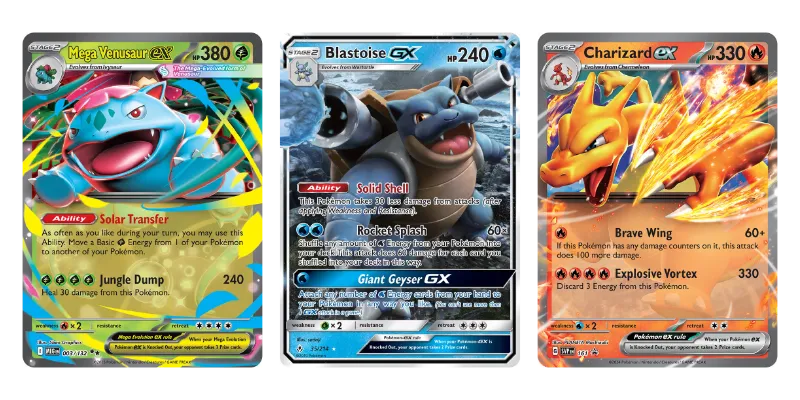 The traditional type triangle in Pokémon is how the starters have one advantage and one weakness: Venusaur is strong against Blastoise, Blastoise against Charizard and Charizard against Venusaur.
In the card game, currently the Weakness means the damage from that type is doubled. So if you bring your Water deck against my Fire deck, you’re likely to win. In a video game, you can easily build a team of six different types but since Pokémon TCG uses Energy cards to power up your attacks, the more types you add, the more difficult it is to power them up consistently.
Resistance plays a smaller part. It’s usually -30 damage which can make certain attacks barely miss a knock out but it’s more coincidental than something players design around.
through archetypes
The other way this balancing mechanic is implemented is through archetypes and individual cards that prevent strategies.
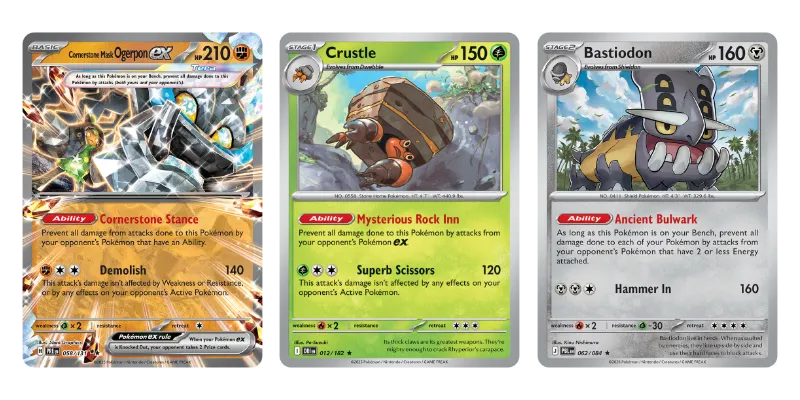 There are cards like Cornerstone Mask Ogerpon ex, Crustle and Bastiodon that prevent damage based on a condition. These cards can completely shut down a deck that wasn’t prepared for it.
They form a backbone for a archetype called Control where the goal is to win by preventing your opponent from winning. There are many ways to build a control deck and it changes based on what cards are available in which formats: sometimes it’s more about aggressively milling your opponent (discarding cards from their deck), sometimes it’s about making it hard for them to attack (cards above, energy denial), sometimes it’s about taking away specific tactics (item or ability locks) and then there was that one Snorlax that everyone hated that stranded a useless Pokémon in the active spot and stopped you from attacking.
Magic the Gathering has similar ways to counter decks and archetypes but I’m not skilled enough in Magic to write a good deep dive on that side.
Building for a meta
“Meta” is a term that is used to describe the best (or most common) strategies currently being played either globally or in a specific tournament or local group. Deckbuilding for a tournament is an exercise in understanding meta and predicting its shifts and being capable of building a deck that’s strong in a specific meta.
Meta adds a lot of depth to a trading card game. There are a lot of cards in Pokémon TCG that can be hard counters to your deck but if nobody’s playing them, you don’t have to worry about them. On the other hand, if a deck becomes prominent because of that, it’s likely the next time people will add cards to counter it.
At a heart of deckbuilding is a balancing act between consistency and flexibility. Consistency is often achieved through simplifying the deck: cut out everything that’s not serving the main strategy. Decks that go all-in for one strategy are easy to counter because they can’t work around the hard counters. Flexibility is achieved through many options or tech cards. They are cards that solve a specific problem but are unusable otherwise.
A few years ago, Mew VMAX was the strongest deck in the format. Pokémon released a hard counter for the deck in Drapion V that directly punished Mew VMAX players’ only strategy. But outside of that one matchup, Drapion V was a dead card that reduced your consistency in every other match — and eventually even Mew VMAX players found a way to counter it.
If you make a right meta prediction, your deck can fly past all other variants of the same deck that made wrong predictions.
There’s no meta in casual play
The problem arises when we play constructed outside a competitive environment. There’s no meta in casual match between two people. If one person brings — intentionally or accidentally — a deck that hard counters their opponent’s deck, there’s no game to play. To guarantee a great, interesting and intellectually inspiring match, you need to intentionally bring decks where one is not directly stronger than the other.
Self-contained gaming environments are a great solution
When you build a SCGE to bring to your casual game sessions, you can control the entire environment. You can craft decks and formats that are balanced and interesting. Environments where nobody else has to bring any decks in and get to enjoy the game.
More and more, I’ve fallen in love with them for their ease of use. I regularly have lunch Magic sessions with a friend to which I build one or two of my SCGEs and we can enjoy good food and then play a few games of Magic by just shuffling up and starting to play.
Many — but not all, we’ll get to that — SCGE formats don’t require any deckbuilding. Either you play with what you draw or you pick up one preconstructed deck from a pool of a few designed to be interesting to play against each other.
Let’s take a look at some of the SCGE’s in Pokémon TCG and Magic the Gathering that I enjoy.
Pools of decks
The easiest one to build and understand is having a pool of decks that are designed to be played together. I have a 5-deck pool of Pokémon TCG from the 2004-2006 EX era as that’s one of the best formats in the history of the game. Games are slower than current Standard format so there’s more interesting decision making and opportunities for comebacks than we currently have.
Similarly for Magic, I recently started building a pool of Pauper decks. I currently have 3 but I’m planning to expand it to 5 to have a nice pool from which to choose so we can have more games with varying decks in a single session and less likely to get bored of a specific deck.
Magic the Gathering also has an interesting concept of Jumpstart decks. They are preconstructed 20 card half-decks where you pick two of them and shuffle them together to play games with 40 card decks. I think they are great for beginners and for casual play as a SCGE. I’ve been recently started designing similar decks for Pokémon TCG as a tool to help introduce new people to the game but that’s still too early to talk about in detail.
Cubes
Cube is the ultimate self-contained gaming environment most players are aware of. It’s a draft environment where instead of buying a bunch of boosters, you have a set of cards that you’ve designed to be drafted over and over again.
Common cube size is around 360 to 720 cards and designed for 8 players but at least in my lived reality, it is so difficult to find a day when 8 adults have time to gather to the same place at the same time that we get to cube draft way too rarely with these big cubes.
2 player cubes are my jam. For Pokémon TCG, I have a 2 player retro cube, 2 player SP era cube and a 2 player Pokémon TCG Pocket cube with printed versions of the digital game.
Cubes solve the problem of not having to do deckbuilding up front or even owning cards before. It is the more time consuming and complex of the SCGEs because it takes time to draft and build decks before you get to play. It also requires more skill in drafting and deckbuilding so it’s more prominent for advanced players wanting to play casually.
For me, a 2 player cube hits a real sweet spot. You get to exercise your thinking muscles as you draft and build, every draft is different and you don’t need a warehouse to store your cube as they fit into a small deckbox. With two players, the drafting doesn’t take hours either as there’s less people making decisions and by selecting a drafting method can even more significantly reduce the time.
For example, I enjoy drafting the Pokémon TCG retro cube with a method where one player draws 8 cards, splits them into two piles and the other chooses which pile they want. This way, you do 10 rounds of drafting and half of them you make a single decision.
I think every TCG player should have some sort of cube they enjoy in their bag or closet for the moments when you do manage to get friends together to draft.
Right now, I don’t have any Magic cubes built but I’ve started planning creating an Animal cube where every creature is an animal.
You can build cubes in any way you want. Set Cubes are built from cards in a specific set. Other cubes are crafted on other themes.
”Boxes”
I don’t quite know what to call these, so I called them “boxes” for now.
A “box” is a format where you share everything but your hand and play board: decks/libraries, discard piles/graveyards, exile/Lost Zone etc.
I have MTG Battle box, Pokemon TCG Lost Zone 2 player shared deck cube and there’s Party Boxes (see PleasantKenobi’s introduction video and Cardmarket’s game play video) and probably even more that I have not heard of.
These are the easiest way to get a game started. Shuffle all cards, draw a hand and start playing. Every play session is different which makes it fun and the limitations of not controlling the entirety of the deck forces reacting to what happens rather than relying on pre-planned strategies.
Special designed formats
Naming these categories is still hard.
Forgetful fish (MTG), also known as Dandân, is a 80 card deck that’s played like a box but it has a very specific design. It’s mono Blue with only one Creature: namesake Dandân. The deck challenges players with a very specific way of playing through counter spells, removals and top deck manipulation.
Narode (Pokémon) is a mirror match of two Pokémon TCG decks that have exactly the same cards. It’s a slow format focused on decision making (through reduced randomness) and resource management.
Magic the Gathering - Basic Land Game is another interesting take. Each player has a deck of just 25 lands (5 of each non-Waste basics). Normally in Magic, lands are played to generate mana to cast other spells but in this game, lands are free spells that each have a specific action and the goal is to either have one of each or all five of one type on the board. It’s a cheap format as basic lands are the cheapest thing you can find in TCGs. A set of 100 basic lands costs a couple of euros in Cardmarket and if you know people who’ve played for a while, you’ll probably get them for free if you ask.
Momir Basic (MGT) is another SCGE but one that requires a bit more tech. It’s a format where your deck is only lands and you can cast random creatures from Magic’s history with a mana value that matches how much mana you paid to cast it. To play in paper, you need some sort of computer and printer that can choose a random card and print it. If you want to see it played, check out this match between Rhystic Studies and Jesse Robkin in Tolarian Community College.