Sometimes you want to play paper TCG games (or chess) but you’re stuck at home or your gaming friends live across the planet. Playing with actual cards beats any digital game million times over so we need some ways to play online with our physical cards.
Here’s my most recent setup that I’ve been using lately with great success.
Main setup
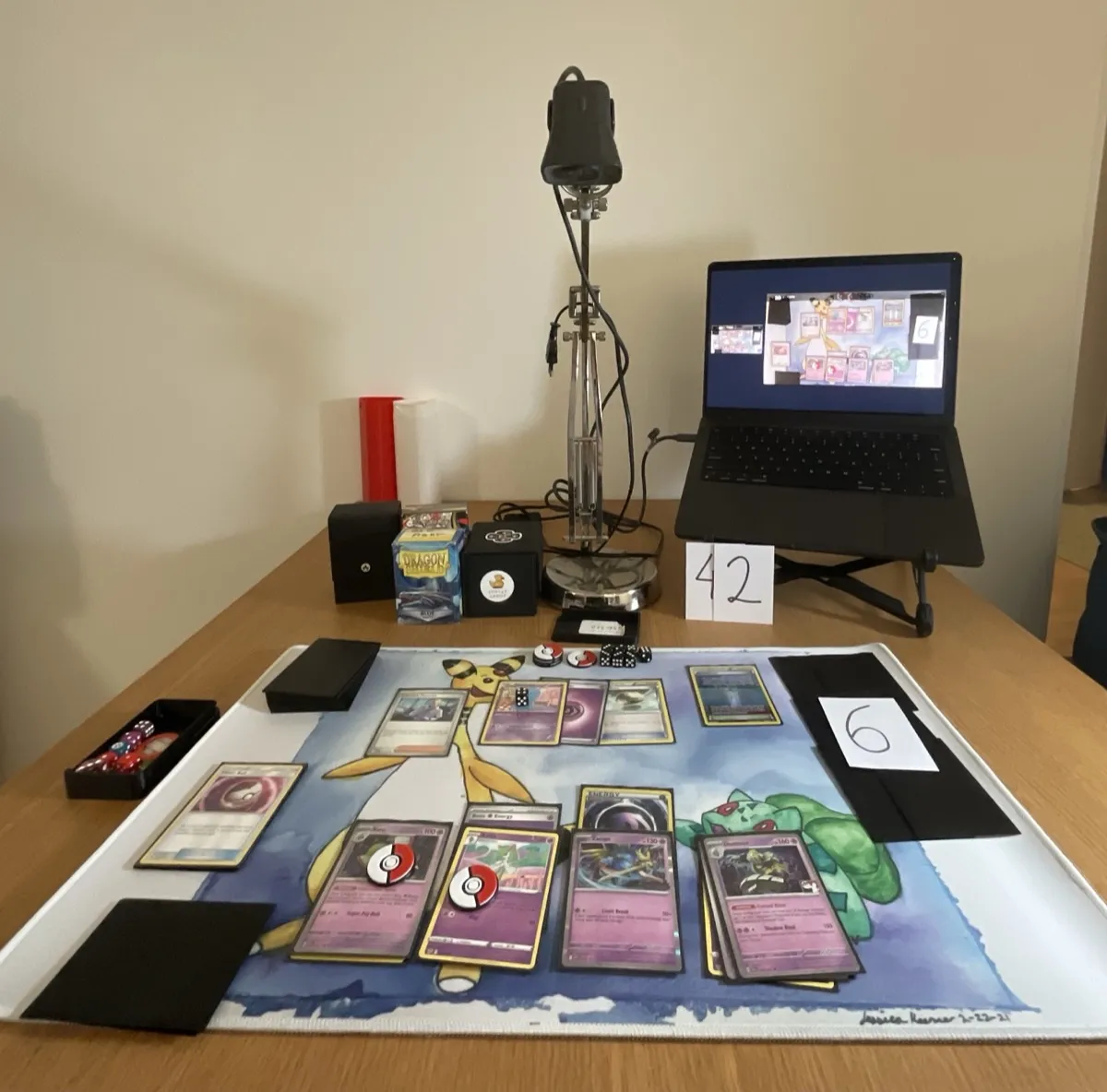
Using a playmat is very handy because it helps keep everything in frame (and picking up cards from playmat is way easier than from a hard table). I have a webcam pointing straight down (see below for details) and an extra light on the right to reduce glare.
The webcam (and my headphones) are attached to the laptop with Spelltable (see How to use Spelltable if you need a quick tutorial) on so I can see my opponent’s table and chat with them. Spelltable is created for Magic the Gathering but it works perfectly fine for Pokemon TCG or any other game as well.
Webcam
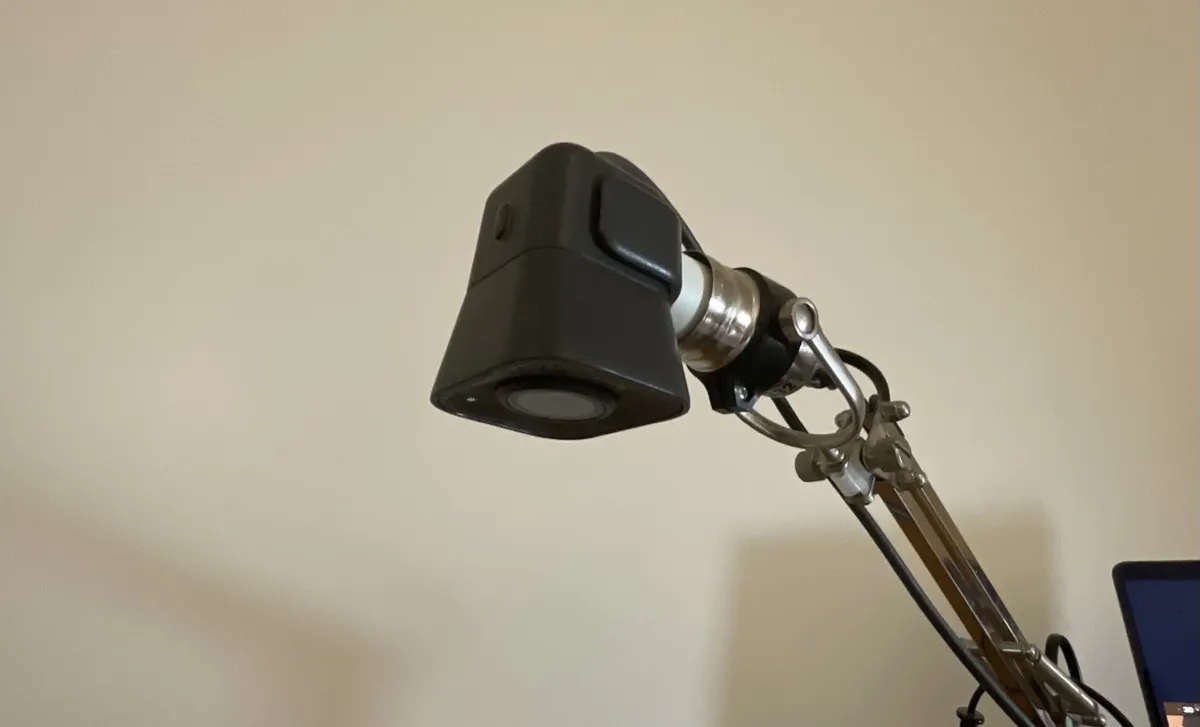
My webcam is Logitech Streamcam which just happens to have an adapter that perfectly and snuggly fits the E27 socket of a lightbulb on my desk lamp stand. This would otherwise be a perfect case for designing and 3D printing to create an adapter for whatever camera and lamp stand you have.
Considerations
When we’re playing over webcam, we don’t have the ability to take a look at the cards on the opponent’s board and hand (their backs, obv) so we need to do a bit of extra communication to keep the game flowing nicely.
If you play against strangers, it also helps build trust and with friends, it’s a good habit to get into. There’s technically nothing preventing you from cheating in a webcam game. If you’re the type of person to do that, just go touch grass instead and stop playing card games, thank you.
When playing Pokemon
I took three pieces of paper and wrote the numbers 1-6 to them with a thick marker and I keep the corresponding one on top of my prizes so it’s easy for my opponent to always know how many prizes I have. Especially with dark, monocolor sleeves it can be tough to see otherwise as there’s no clear separation between cards.
Keep attached cards visible. I lay out my Active Pokémon in a way that all the energies and tools are clearly visible so my opponent doesn’t have to keep guessing and asking. On the bench, there’s bit less space but I try to do my best to show what there are on the board.
I like leaving the supporter card on the board after it’s been played for the entire turn so it’s clear for both players that one has been played.
I use 3D printed Poké Ball counters to signify which abilities have been used. It’s a good idea to use something for that. It could be a piece of paper, the backside of poison/burn counters and whatever you have around. Just make it clear to both.
When you draw cards, lay them out one by one on the board to clearly communicate how many are being drawn. I like to also communicate how many I’m drawing when I play a card: sometimes the amounts change based on board state and sometimes there might be cards your opponent isn’t familiar with.
If you see a card that you’re not familiar with, ask what it is and what it does! If someone asks you, be proactive and give out the information. It can be hard to read the cards from a laptop screen with less than perfect webcam resolution so it’s nice to be a good communicator.
When it’s not your turn, put your hand down and put some dice on top to indicate how many cards you have in hand.