We organised an 8 player Hobbit booster box draft with our friend group. It was my second ever Magic draft (first being Avatar draft). I went into this draft trying to study more of the archetypes this set had and had a good idea of what I was looking to draft.
Draft
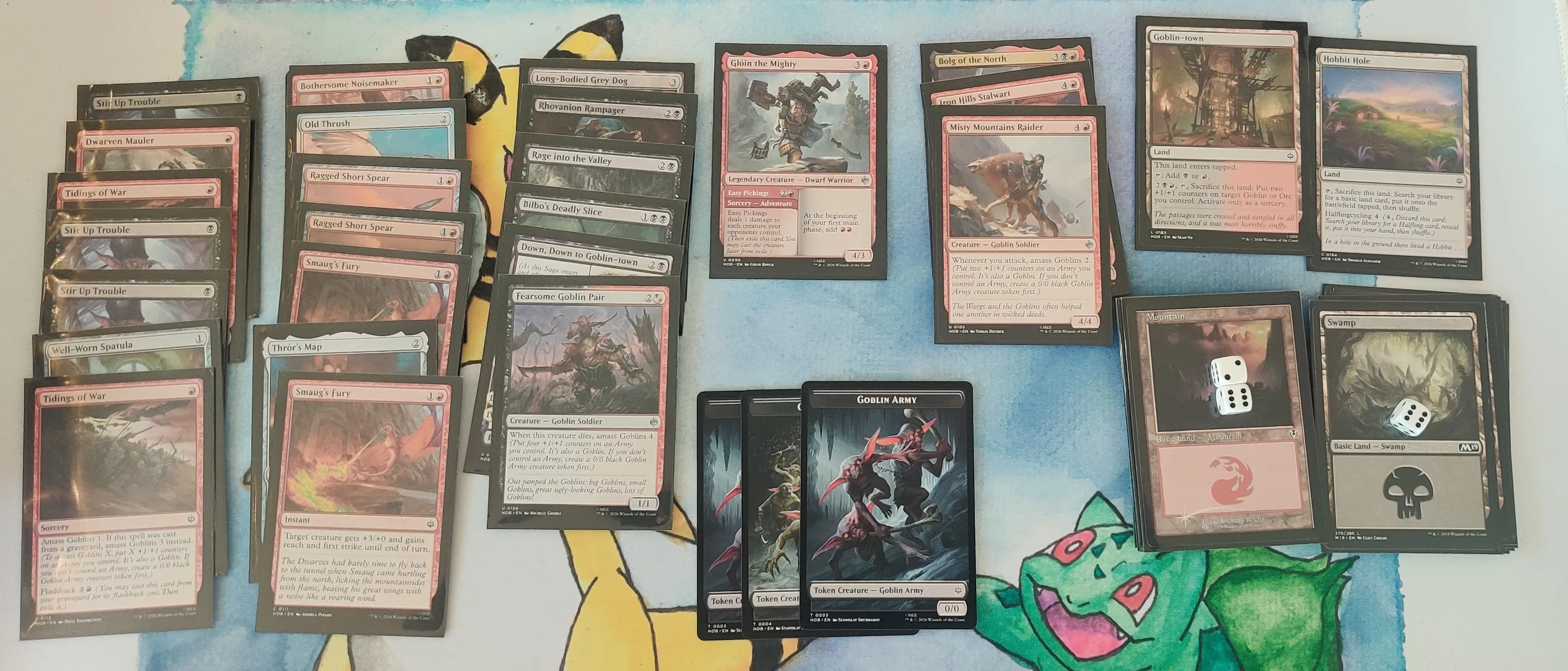
1 Bilbo's Deadly Slice (HOB) 62
1 Bolg of the North (HOB) 148
1 Bothersome Noisemaker (HOB) 89
1 Down, Down to Goblin-town (HOB) 65
1 Dwarven Mauler (HOB) 95
1 Fearsome Goblin Pair (HOB) 156
1 Glóin the Mighty / Easy Pickings (HOB) 99
1 Iron Hills Stalwart (HOB) 102
1 Long-Bodied Grey Dog (HOB) 1
1 Misty Mountains Raider (HOB) 105
1 Old Thrush (HOB) 2
1 Rage into the Valley (HOB) 79
2 Ragged Short Spear (HOB) 108
1 Rhovanion Rampager (HOB) 298
2 Smaug's Fury (HOB) 111
3 Stir Up Trouble (HOB) 84
1 Thrór's Map (HOB) 179
2 Tidings of War (HOB) 115
1 Well-Worn Spatula (HOB) 180

6 Swamp (J25) 89
8 Mountain (J25) 90
1 Goblin-town (HOB) 183
1 Hobbit Hole (HOB) 184
I drafted a black/red Goblin Amass deck as seen above. At the end of the draft, I felt good about what I had picked. A strong Goblin Amass engine with plenty of removal (3x Stir Up Trouble and Bilbo’s Deadly Slice), and some evasion (2x Old Thrush, one that I took away after first match).
The deck ended up not being very good. It was poorly drafted and constructed and I learned really quickly why.
As a background, I play way more Pokemon TCG than Magic. In Pokémon, you’re very rarely in a situation where you run out of cards in hand, especially for multiple turns as there’s a lot of ways to refresh your hand.
I was looking at my list and figured that my cheap spells play well with the Amass Goblin engine and that I’d rather play three of my 2 mana synergy pieces than a 6 mana big creature. What I learned the hard way today is that I won’t have three 2 mana spells on turn 6 or 7 to play and thus my small creatures will run out of steam.
In multiple matches, I had a great start: I was amassing my Goblin Army and removing their big threats but my damage output to player remained low. Eventually, they’d run me out of removal and overwhelm my board. That was the result of the main mistake of failing the curve in drafting and deck building.
Matches
Round 1: 1-1 draw against black/green Ferocious deck
I had a really good first game and had a good feeling about my deck at this point. I was able to follow my strategy and aggro overwhelm my opponent.
In second game, they got their big Ferocious and token creation pieces out and I didn’t manage to remove them and they beat me quite handily.
We went to time and I managed to survive with 5 life points — I would have lost if there had been one more turn.
Round 2: 1-1 draw against white/red Dwarf & Wizards Storied deck
The second match was a complete 180 to the first. They got their deck up and running with a bunch of Legendary Dwarfs, Gandalf and The Arkenstone and I had no chance.
Game two, I was able to remove their worst creatures before they came to the play and at that point, I had a big 8/8 Goblin Army that took out the ones I could remove with spells every time they entered the field. Eventually, they would have lost to decking out because the game went so long.
Round 3: 1-2 loss against blue/white control
The last match was a really quick three rounds against a cool control deck that played a lot of flyers, mill and draw manipulation. Once again, I ran out of steam too quickly and in the end game, they had big creatures and I had nothing. Especially since my Goblin Army didn’t learn to fly or reach to the skies and stop the flying beasts.
Wrap up
It was a really fun day. I learned a ton about drafting and playing draft decks and will hopefully remember them next time: that’s why I document these events to my notes. When I drafted Avatar, I just took cards that looked interesting. This time, I learned all five archetypes before hand and went into the draft with a clear plan and that was a great decision.
One day, I’ll learn how to build good decks: now that I’ve understood the archetypes, it’s time to focus on learning about the mana curve and how to use that new understanding to better draft and build decks.
It’s also cool that there’s a whole book explaining the lore of this set.